Scientific Computing Seminar: Challenges and opportunities for Hybrid Quantum-Classical Systems
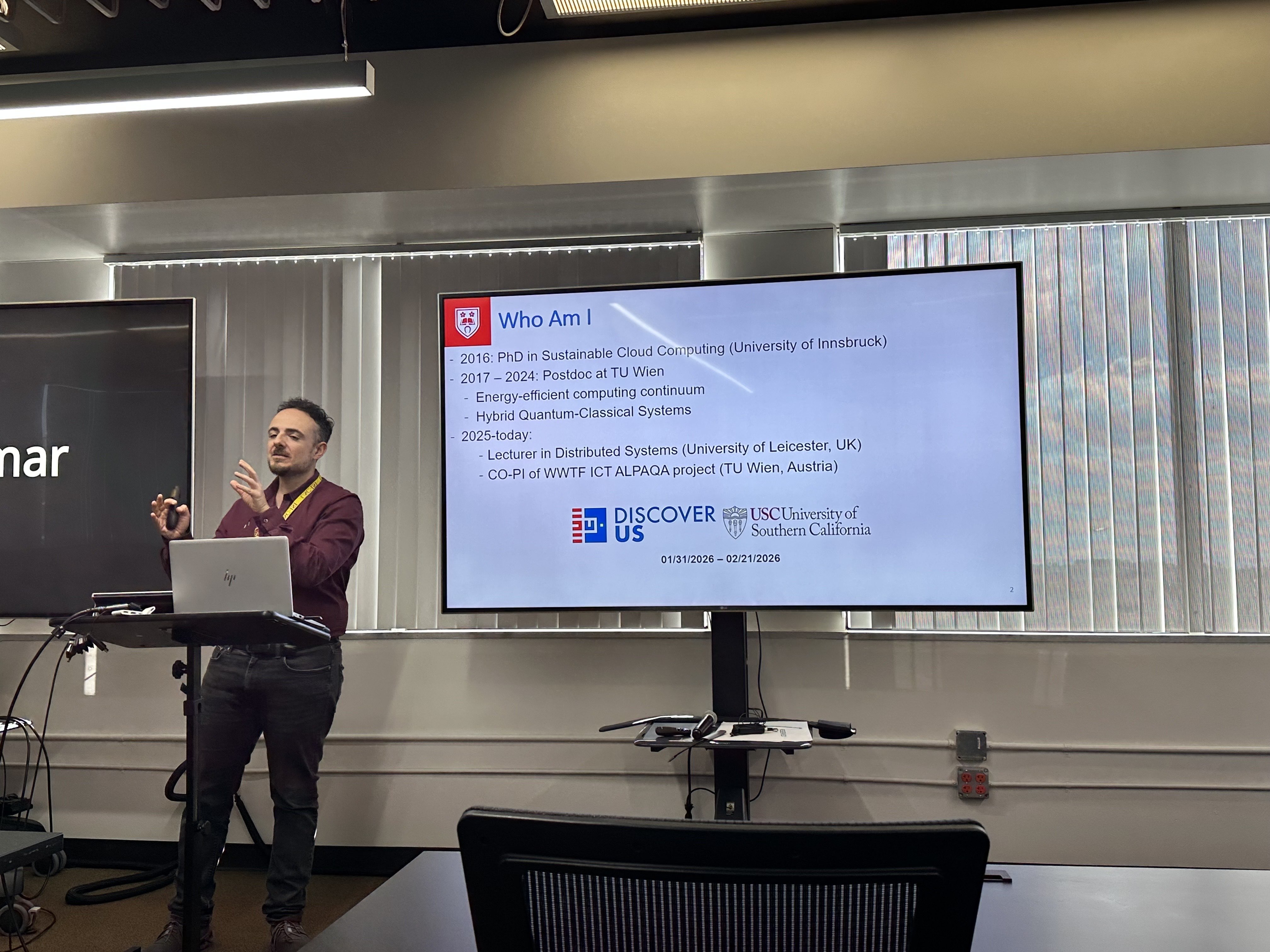
Quantum computers promise transformative performance for certain classes of scientific and engineering problems, but today’s devices are limited in size, reliability, and scalability. My research addresses this gap by advancing hybrid quantum‑classical computing and high‑performance distributed systems to make quantum acceleration useful now and at scale. In this talk, Vincenzo De Maio will present an overview of the three key pillars of his work:
1) Understanding and Optimizing Hybrid Quantum-Classical workflows: We analyse how classical HPC workflows interact with quantum tasks, identify where current orchestration fails and how to fully harness classical and quantum hardware efficiently.
2) Hybrid Quantum-Classical Applications: We focus on the state of current Hybrid Quantum-Classical applications, mainly focusing on Quantum Optimization and Quantum Machine Learning, identifying the current limitations and possible future research directions.
3) Identifying footprint of Hybrid Quantum-Classical Applications: We will characterize the computational, memory, communication and energy demands of hybrid quantum-classical applications, uncovering performance bottlenecks, quantifying hardware utilization and providing guidelines for efficient deployment on Hybrid Quantum-Classical Systems.
- When: Friday, February 2nd, 2026, 10:30am – 12:00pm PDT
- Where: MDR #1014 Conference Room
- This event is open to the public.
- Type: Scientific Computing Seminar
- Recording of Seminar:

Speaker: Vincenzo De Maio, TU Wien
Bio:
Vincenzo De Maio is a Lecturer in Distributed Systems at the University of Leicester and as co-PI for WWTF ALPAQA Project in TU Wien. His research focuses on Quantum Computing, with an emphasis on Integrating of Quantum Computers into HPC environments, Quantum Machine Learning, and Quantum Optimization, as well as Edge/Cloud Computing, Sustainable Computing and Distributed Systems. He has authored more than 30 peer-reviewed papers in top venues such as FGCS, ICLR, and TSUSC, laying the foundations of Hybrid Quantum-Classical Scientific workflows. He is also a member of HiPEAC and DISCOVER-US networks.